

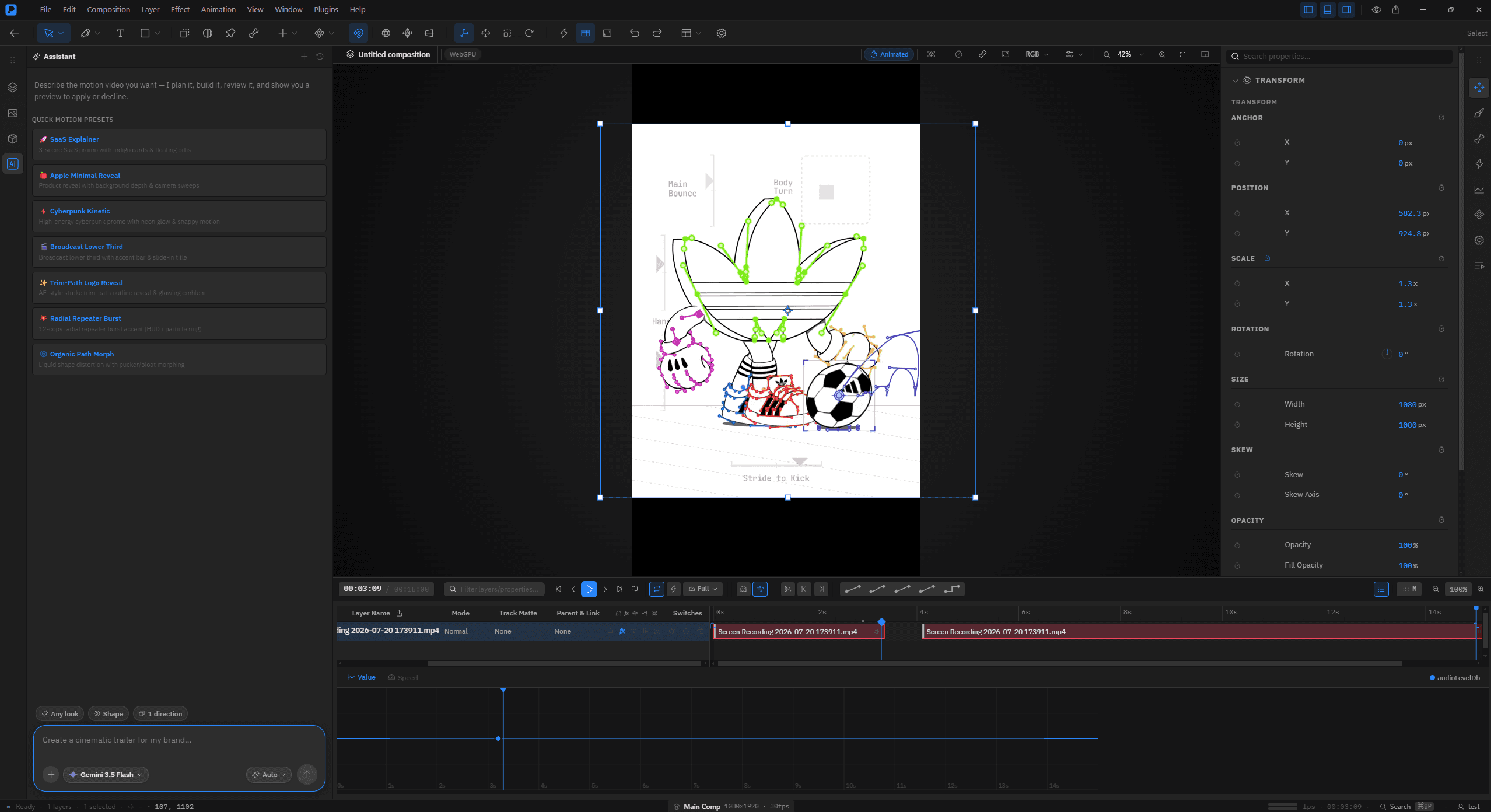
The assistant
It calls the same operations the interface does, so what it makes is editable — from the in-app assistant, or from Claude, ChatGPT, Cursor or Antigravity connected from outside.
Download PremationFree, AGPL-3.0-only, for Windows, macOS and Linux
73typed tools
What you can do
10 capabilities, all in the build you can download today.
- Bring your own key
- Anthropic, OpenAI or Gemini, on your own account. No credits and no plan gate — you pay your provider, not us.
- Assistant connections
- New in 1.0. Dashboard ▸ Connections connects Claude Desktop, Claude Code, ChatGPT desktop and the Codex CLI and IDE extension (through ~/.codex/config.toml), Cursor or Antigravity to a local MCP server on your computer. Free on every plan. ChatGPT on the web cannot start a local server, so it cannot connect.
- You stay in charge
- A connected assistant edits the project you have open while you watch. Stop ends what it is doing, each request it makes is one step in Edit ▸ Undo, and it asks before importing files or rendering a video: you click Allow or Deny.
- In both editions
- The assistant is in the installers and in a build made from the open-source repository. Only where the key lives differs.
- One prompt, one undo
- Everything a run touches lands in a single history entry.
- Reads the document
- Describes the scene, reads tracks, evaluates a property at a time, lists what is available.
- Writes real edits
- Creates layers, sets keyframes and easing, applies effects and presets, builds rigs, poses skeletons.
- Composition tools
- Higher-level moves backed by a hand-authored technique library: titles, lower thirds, logo reveals, camera moves, transitions.
- Self-critique
- A fit critic reviews rendered frames as evidence before the run is accepted.
- Keys never reach the renderer
- In the local edition the key is held in the OS keystore by the desktop shell's main process, which makes the call behind a per-provider endpoint allowlist; the page never sees it. In the installers the key is stored encrypted on our server.
Read further
The documentation for this area, in the order it is worth reading.